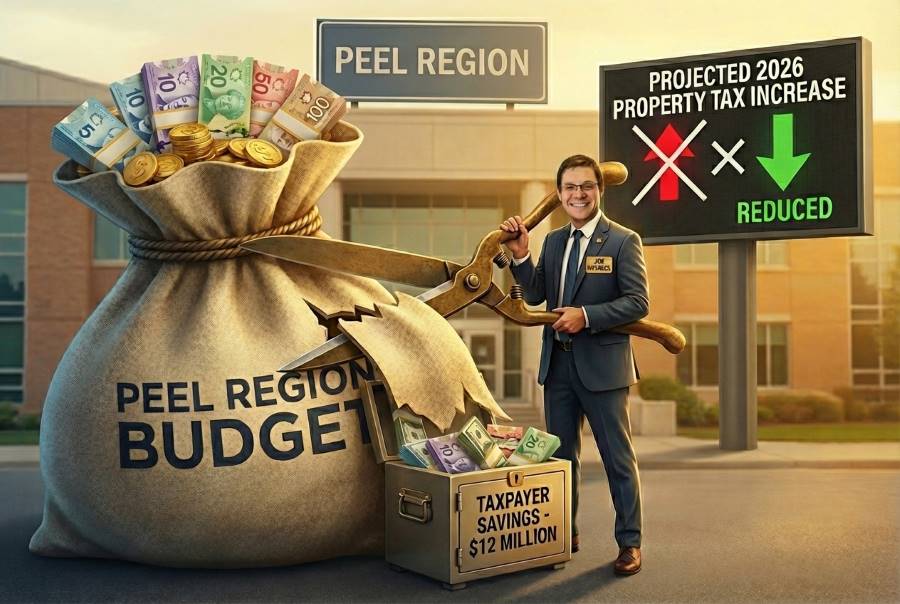
Approved Tax Savings
Councillor Joe Horneck successfully introduced a series of 2026 Peel Region budget measures that reduce the property tax increase for residents while maintaining essential regional services.
Regional Council has now approved these measures, which build on the direction Council set in July 2025, when a motion from Councillor Horneck and Councillor Brad Butt committed the Region to a Net Zero increase in Full-Time Equivalent positions (FTEs) across most departments.
Together, the July motion and the newly approved 2026 Budget motion achieve approximately $12-million in savings, helping moderate this year’s budget increases while preserving frontline services during a period of significant structural transition for the Region.
Affordability a Priority
Affordability remains a major concern for households across Peel. Labour costs continue to be the single largest driver of Regional expenditures, and without careful oversight these pressures would have led to a substantially higher 2026 property tax increase.
The Region also continues moving select services toward a new single-tier governance model, with responsibilities shifting to the Cities of Mississauga, Brampton and Caledon. This transition creates opportunities to realign staffing levels and labour budgets with the evolving role of the Region.
To make sure residents were protected and Council’s July direction was upheld, Councillor Horneck conducted an extensive review of the hundreds of pages of financial and operational documents presented to Council. This included:
- The Budget Overview
- The Reserves and Reserve Funds analysis
- All departmental service presentations
He reviewed every financial line presented to Council, examined the staffing and complement pressures behind the budget, and focused on identifying areas where responsible and technically feasible reductions could be made—particularly in non-frontline administrative areas and areas transitioning to the Cities.
Throughout the budget process, the Councillor:
- asked detailed questions during staff presentations,
- sought clarifications and follow-ups from senior staff,
- had several staff reach out proactively due to the number of his inquiries, and
- consulted with City of Mississauga technical staff, the Mayor of Mississauga, the Mayor of Brampton, multiple Mississauga and Regional Councillors, and others involved in transition planning.
This collaborative and thorough review helped ensure that the final recommendations were grounded in operational reality.
What Council Approved
The adopted motion includes several targeted measures designed to reduce pressures without affecting essential frontline services.
- Administrative staffing efficiencies
A reduction of 30 administrative FTEs across Business Services, Clerks, and Real Property & Asset Management. These changes target areas where complement adjustments can be responsibly managed while protecting frontline operations.
- Labour savings aligned with transition to the Cities
Because responsibilities in Development Services are shifting to the local municipalities, Council approved a $2 million reduction in labour costs in 2026.
- Holding the Water Infrastructure Levy at 5%
Instead of increasing the levy to 6%, Council approved holding it at 5%, easing pressure on utility ratepayers while maintaining the ability to adjust project timing as needed.
- Transition-focused hiring restrictions
To avoid adding permanent staff in areas trasferring to the Cities:
- Permanent hiring in Roads will pause, with contract positions used as needed until transition dates.
- Waste Management will limit new hiring to contract roles for future positions beginning after March 1, 2026.
- Savings previously identified in Appendix VI
The Region had already absorbed over $8 million in staff-recommended reductions as part of the base 2026 Budget (Appendix VI). These savings did not require further approval as they were incorporated directly into the proposed budget.
Total 2026 Savings
By combining the reductions already built into the 2026 Budget presented by staff with the new measures approved through this motion and the July motion, Council achieved approximately: $12.25 million in total savings
This reduced the property tax increase increase for 2026.
Why This Matters
While these cuts are not everything Councillor Horneck worked for, the $12-million in savings do help towards:
- The Region delivering on its commitment to moderate tax and rate increases.
- Frontline services remaining strong and uninterrupted.
- Staffing levels reflecting the transition toward more single-tier municipal governance.
- Residents being protected during a period of high affordability pressures.
- Council staying accountable to the commitments it made earlier in the year.
Budget-making always involves careful choices, and some of these changes require operational adjustments. However, they were chosen with a focus on minimizing impacts on residents while aligning the Region with its new governance structure and long-term financial responsibilities.
What Happens Next
Staff will report back to Council by March 1, 2026 on the implementation of these measures. The Region will continue preparing for the transition to the Cities, and Council will monitor both service delivery impacts and financial outcomes carefully.
Residents are encouraged to contact the Councillor’s office with any questions about the 2026 Budget, the approved savings, or how these decisions will help keep Peel affordable and service-focused during this time of change.